
Understanding knee pain
Knee pain can show up in lots of different ways. For some people, it is a sharp twinge when running, climbing stairs or squatting. For others, it feels more like stiffness, a dull ache, or a sense that the knee does not feel as steady as it used to.
It is easy to assume the knee itself is always the problem, but that is not usually the full picture. The knee sits between the hip and the foot, which means it is affected by what is happening above and below it. Weakness in the glutes, quads or hamstrings can change how the leg moves. Limited hip or ankle mobility can also place more strain on the knee. Over time, that can lead to irritation, poor patella tracking, stiffness or pain during everyday movement.
This is why knee-strengthening exercises should not focus solely on the knee joint. A good recovery plan looks at the whole chain, from the feet and ankles through to the hips and pelvis. The aim is to help the knee move with better support, better control and less unnecessary strain.
Pilates can be a useful part of that process because it is built around controlled movement, alignment, balance and strength. Rather than rushing through repetitions, you are encouraged to notice how the body is moving. That can be especially helpful if your knee pain is linked to poor control, weakness, overuse or a return to exercise after injury.
Why Pilates can help with knee pain
Pilates is well-suited to knee recovery because it allows you to build strength without relying on high-impact exercise. If running, jumping, deep squats or long walks currently aggravate your symptoms, low-impact exercises for knee pain can give you a better starting point.
A lot of knee problems are affected by how the leg behaves under load. If the hip drops, the knee rolls inwards, or the foot collapses, the knee can take more pressure than it should. Pilates helps by improving control through the hips, glutes, thighs and core, so the knee is better supported during movement.
That support matters in everyday life. Walking downstairs, getting up from a chair, stepping off a kerb, running for a train or returning to sport all require the knee to manage load. Pilates gives you the chance to practise those movement patterns in a slower, more precise way, which can help rebuild confidence.
For people dealing with patellofemoral pain, runner’s knee, knee stiffness or general knee weakness, the focus is usually on improving strength, alignment and control. Pilates can support all three. It can help strengthen the muscles around the knee, improve hip stability and encourage smoother movement through the joint.
Why Reformer Pilates is useful for knee recovery
Reformer Pilates can be particularly helpful because the spring resistance can be adjusted. That means exercises can be made lighter and more supported when the knee is sensitive, then gradually progressed as strength improves.
This is useful because knee recovery is rarely about doing the hardest version of an exercise straight away. It is about finding the right level of challenge. Too little and the muscles do not adapt. Too much and the knee may become irritated. The Reformer gives more control over that middle ground.
For example, footwork on the Reformer can help strengthen the quads, hamstrings, calves and glutes in a supported position. You are still working the legs, but without the full bodyweight load of a squat. That can be a good option for people who need to build strength but are not yet comfortable with standing exercises.
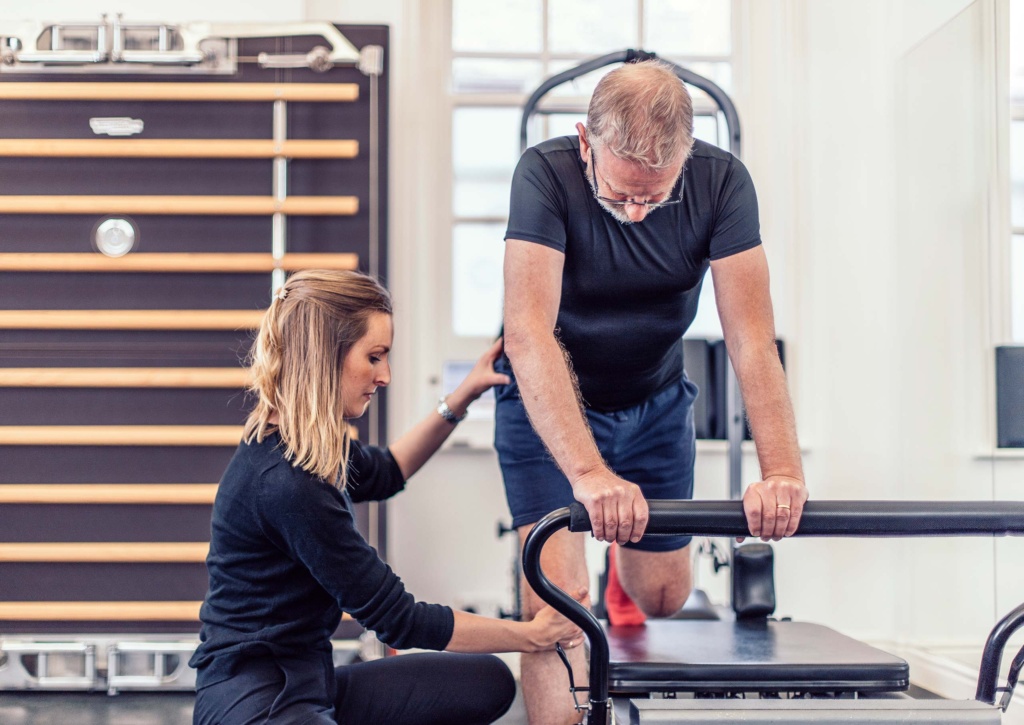
The Reformer also helps with alignment. Because the movement is controlled, your instructor can watch how your knees track, whether one side is working harder than the other, and whether your hips and feet are contributing to the issue. Small corrections can make a big difference, especially if your knee pain has been building over time.
At Ten, this is where the link between Pilates and physiotherapy is important. If you are recovering from an injury, managing recurring knee pain or trying to return to running, the right support can help you progress safely rather than guessing which exercises to do.
The role of glutes, hips and knee alignment
Many people searching for glute exercises for knee pain are already close to one of the key areas to address. The glutes help control the thigh bone, which influences the position of the knee. If the glutes are not doing enough, the knee may drift inwards during squats, lunges, step-ups or running.
This inward movement can place extra pressure around the kneecap and may contribute to patellofemoral pain. It can also make the knee feel less stable, particularly during single-leg movements.
Pilates exercises often work the glutes, hips and core together. That is one of the reasons they can be so useful. Instead of isolating one muscle and hoping it transfers into real movement, Pilates teaches the body to coordinate. You learn how the pelvis, hips, knees and feet work together.
Knee alignment exercises are also a big part of this. In a class or one-to-one session, an instructor can help you notice whether your knee is tracking over your toes, whether the foot is rolling in, and whether you are gripping through the wrong areas. This kind of awareness is hard to build if you are simply following a generic list of exercises at home.
Pilates exercises that may support knee recovery
The right exercises will depend on your symptoms, strength, mobility and injury history. If your knee pain is sharp, swollen, worsening or linked to trauma, it is best to get assessed before starting a new programme.
That said, there are several Pilates-based movements commonly used to support knee rehabilitation, knee prehab and better lower-limb control.
Reformer footwork
Reformer footwork is often a useful place to start. You lie on your back with your feet on the footbar, then press the carriage away and return with control.
It may look straightforward, but it can do a lot. The movement strengthens the quads, hamstrings, glutes and calves while giving you time to focus on knee alignment. Because you are lying down, it can feel more supported than a standing squat, which is helpful if the knee is not ready for full bodyweight loading.
Different foot positions can also change the focus. Working through the heels may encourage more glute and hamstring engagement. Working through the balls of the feet can bring in the calves. The important thing is that the knees move smoothly and do not collapse inwards or lock back at the end of the movement.
Bridges
Bridges are a simple but effective exercise for glute and hamstring strength. These muscles help support the knee from above, particularly during walking, climbing stairs and running.
You start lying on your back with your knees bent and feet flat. From there, you press through the feet and lift the hips, keeping the movement smooth and controlled. The aim is not to lift as high as possible. It is to use the glutes well, keep the knees aligned and avoid overworking the lower back.
On the Reformer, bridges can be progressed using the moving carriage or spring resistance. This makes the exercise more challenging without losing the focus on control.
Clams and side-lying leg work
Clams and side-lying leg lifts are often used for knee pain because they target the muscles around the outside of the hip. These muscles help control the position of the thigh and knee.
If your knees roll inwards when you squat, run or step down, this type of work may be useful. The movement should be small, controlled and precise. You are not trying to throw the leg as high as possible. You are trying to build strength in the muscles that help keep the knee steady.
These exercises are also easy to adapt. They can be done on the mat, with a resistance band, or as part of a more structured Pilates session.
Leg circles and hip control
Leg circles can help improve hip mobility and control. On the Reformer, they are usually performed with the feet in straps. The legs move while the pelvis stays steady, which challenges the hips, core and inner thighs.
This can be useful for knee pain because restricted hip movement can increase the demand on the knee. If the hip does not move well, the knee may compensate. Improving hip control can help the whole leg move more efficiently.
The key is to keep the movement slow and even. If one leg feels less controlled, that may highlight an imbalance worth working on.
Step-ups and single-leg control
A lot of knee pain shows up when one leg has to take more load. Running, walking, stairs and stepping off a kerb all involve single-leg control.
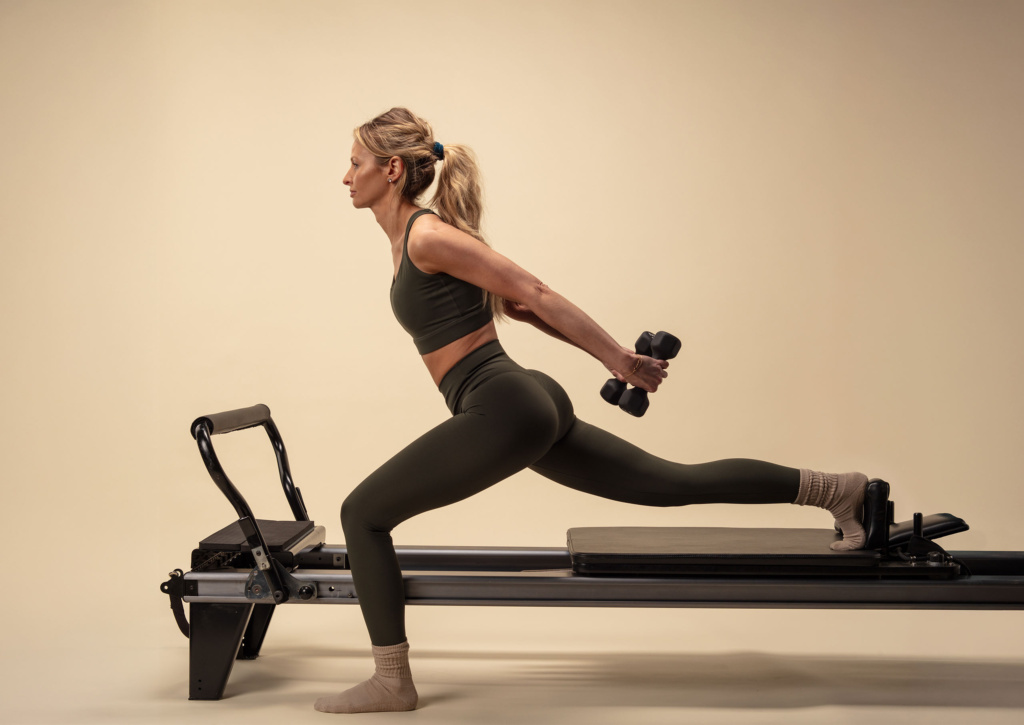
Step-ups, supported lunges and standing balance work can help build that control. The focus should be on keeping the knee aligned, moving steadily and avoiding any collapse through the hip, knee or foot.
This is especially important for runners. Runner’s knee is often linked to repeated loading through the same movement pattern. Improving single-leg control can help the body better absorb and manage load when you return to running.
Wall squats and supported squats
Wall squats can be helpful when they are done at the right level. They build quad strength and help you practise knee alignment in a more supported way.
You do not need to go into a deep squat. For many people, a smaller range is more useful at first. The goal is to move without pain, keep the knees tracking well and build tolerance gradually.
As strength improves, the range can increase and the exercise can become more challenging. This is where guidance matters, because the right progression will depend on how your knee responds.
Knee prehab and returning to exercise
Pilates is not only useful after knee pain has started. It can also be part of knee prehab, especially if you run, play sports, lift weights or have had knee problems before.
Prehab is about building strength and control before issues become bigger. It can include glute strengthening, quad control, hamstring work, calf strength, balance and mobility. These are all areas that can be addressed through Pilates, especially when the programme is tailored to the person.
For runners, knee strengthening should include more than simply adding mileage or stretching after a run. It should look at how the leg manages impact, whether the hips are controlling the knee well, and whether the body has enough strength to tolerate the training load.
Pilates can help by slowing the movement down. It gives you space to work on the details that can be missed during running, such as alignment, balance, control and even weight distribution through the feet.
When to use Pilates alongside physiotherapy
Pilates can support knee pain recovery, but it should not replace proper assessment if symptoms are persistent, severe or getting worse.
Physiotherapy can help identify what is driving the pain. That might include joint irritation, muscle weakness, poor patella tracking, reduced mobility, training overload or a previous injury that has changed the way you move.
Pilates can then help reinforce the work done in physiotherapy. For example, if a physio identifies weak glutes or poor single-leg control, Pilates can provide a structured way to practise those movements and build strength over time.
At Ten, the benefit is that Pilates, physiotherapy, massage and clinical exercise sit closely together. For someone with knee pain, that can mean starting with an assessment, moving into supported Reformer work, and progressing into more dynamic classes when the knee is ready.
How often should you do Pilates for knee pain?
There is no one-size-fits-all answer. It depends on the cause of your knee pain, how irritable the joint is, and what else you are doing during the week.
For many people, one or two sessions a week is a sensible starting point. That gives the body enough regular practice to build strength and awareness without doing too much too soon.
The important thing is how your knee feels during and after. Mild muscle fatigue is normal. Sharp pain, swelling or symptoms that feel worse the next day may mean the exercise needs to be adjusted.
A good session should feel controlled and useful. You should feel that the knee has worked, but not that it has been pushed beyond what it can handle.
Expert Opinion – Juanita Jordan – Physiotherapist
“If you have knee pain, try not to focus only on the knee. Look at how the whole leg is moving, including the hips, glutes, quads, hamstrings, calves and feet.
Start with control before intensity. Exercises should feel steady and well aligned before they become harder. If the knee becomes sharper, swollen or more painful afterwards, reduce the load and get professional advice.
Pilates can be a valuable part of knee pain recovery because it helps you build strength, improve alignment and trust your movement again. The best results usually come when it is combined with good assessment, sensible progression and a plan that matches what your knee can manage.”